Visitor centres
This page tells you a little bit more about the places where you could see a Phillipine Tarsier.
Bohol
There are two places you can see Tarsiers in Bohol.
Most tours of Bohol will take you to the road towards the Tarsier Foundations Visitor Centre first where there are a number of stands on the side of the road that you can see and feed the Tarsiers they have there. These stands have government permits to do this but are a source of concern to animal conservationists. Many of our close-up photographs are taken at this site.
If you move on to the Foundation in Corella township, the Philippine Tarsier Foundation Inc., has set up a research and study centre. Attempts have been made to breed the species in captivity and are sometimes successful. You can read more about this in the Foundations own web pages on our links page.
At the Foundation you will find a building where there is a small display on the Tarsier showing the skeleton, food, and other exhibits with help you understand the primate in its natural habitat. Here also you can go on the Tarsier Trail.
The Foundation has a trail that is a pathway that meanders through the gentle rolling terrain of the interior towns of Corella, Sikatuna and Loboc, north of Tagbilaran City, the Capital of Bohol.
This is over a distance of roughly 15 kilometers and it traverses the natural habitat of the Philippine Tarsiers giving you various vantage points from which you might just see a glimpse of the Tarsiers. The guides there will be able to point out where they are nestling in the bushes and trees.
While you can take photographs, you must not use flash and to get the best photo's you will need a small telescopic lens. Tarsiers are nocturnal and are usually asleep during the day so you might not see one awake.
The British Prince Charles came to the Philippines and was presented with a Tarsier by the President. However, being understanding of the very frail numbers and that they do not like to be separated from their loved ones he graciously asked the Philippine President to make sure that the Tarsier was kept in Corella with its relatives.
The Philippines Tarsier Foundation Inc,
14 Canapnapan
Corella
Bohol 6337
Philippines
Tel: (0912) 5163375
E-Mail: tarsier_foundation@yahoo.com
Website: www.tarsierfoundation.org
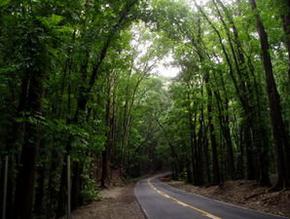
In the municipalities of Anda, Loboc and Corella on Bohol are, what are believed to be, the only man-made rain forests of the world. Bohol was once covered in forests but these had been torn down for building and to make the land more appropriate for growing bananas, coconuts and other plants. However, this was stopped in these three areas and trees planted in a sustainable man-made forest. The trees are mahogany and balsa mainly but there are also some banyan trees that are favoured by the Tarsier. You can drive through the forest. Stop and take a picture of the cathedral of tall trees along the roads.
Linan
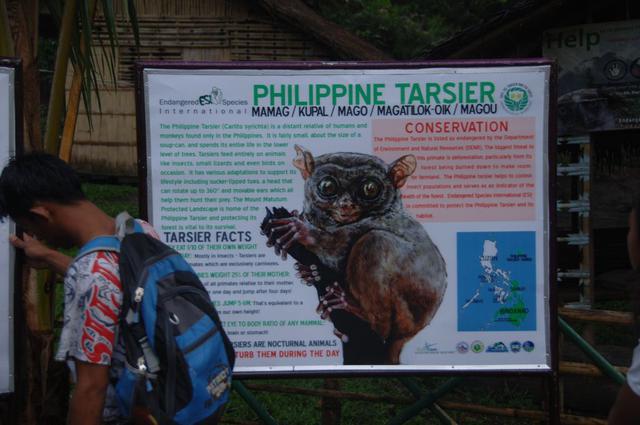
Linan is a small village (Barangay) near the municipality of Tupi in the South Cotabato region of the Philippines. It is on the large island in the south of the Philippines chain known as Mindanao and under the extinct classic cone shaped volcano of Mount Matutum.
Here there is a new project involving the Tarsier. Although there has been rumour of Tarsiers present on the island of Mindanao, there has never been much evidence of this. However, the small group of indigenous peoples in Linan regularly trapped them for food and to sell to others. The local Tupi town government heard about this and found a trapped Tarsier in a cage, confirming their presence on the mountain side.
Endangers Species International (a United States based Charity) became involved, working with the Tupi Officials and the indigenous peoples in 2011.
The project is to look at the environment of the Tarsiers in the vicinity of Linan and to protect the existing habitat and populations of the Tarsier there while extending the habitat and to provide a sustainable living for the local peoples away from the hunting Tarsiers as well as the deforestation of their habitat to create more farming space. To do this the organisation is working with the local B'laan indigenous people helping them understand the need to retain Tarsiers in the area and training them to assist the project.
At the start of the project they are helping to release any Tarsiers that are found in captivity in the area, planting new trees to re-forest much of the area illegally cleared of trees and establishing the area on the mount Matutum where the Tarsiers live.
It is hoped that in the future ESI will support the establishment of a visitor centre and a farm run by the local indigenous people (the B'laan) to support their hamlet of families. They have also found and released more Tarsiers putting these through a new rehabilitation process to hlep them return to the wild.
So far, the project has:
- Held organic training 2-day sessions with local B'laan peoples and wild mushroom growing
- Held training for 40 B'laan ladies on the production of toy Tarsiers for the Tourist industry
- The placement of interpretive signs in the region
- The planting of 400 trees in one week
- A native tree nursery established in 2012
- Several Tarsiers found in captivity and released through ESI's rehabilitation centre
- The commencement of building a museum on the cultural history of the B'laan peoples and the re-introduction of centuries old traditions.
Pierre from Endangered Species International says "Tarsiers live in secondary and primary forests, so if there is no forest, they are gone. Our project is located in an area that used to be covered by giant trees and we are planting trees in open areas (like grasslands) and where some canopy already exists. The goal is to increase natural forest coverage to avoid erosion and landslides and to bring back biodiversity,”
Trees being planted include nabol, (Elaeocarpus gigantifolius), Philippine teak (Tectona philippinensis), white lauan (Shorea contorta), molave (Vitex parviflora) and narra (Pterocarpus indicus).